
Jinan Unveils Five-Year Roadmap for Its Modern Pharmaceutical Industry, Targeting RMB 420 Billion in Industrial Chain Value by 2030
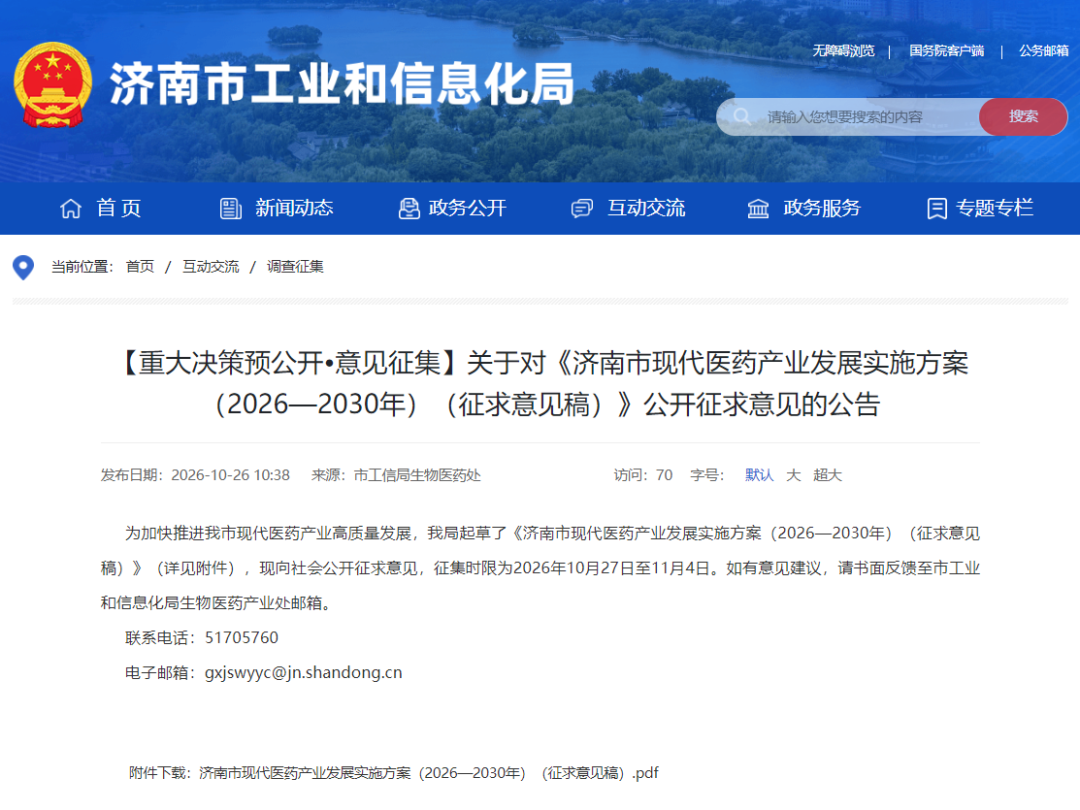
As one of Jinan's 13 strategically prioritized industrial chains, the modern pharmaceutical industry is set to enter a new stage of development. Recently, the Implementation Plan for the Development of Jinan's Modern Pharmaceutical Industry (2026–2030) (Draft for Public Consultation) (hereinafter referred to as the Draft Plan) was released for public feedback, outlining the city's development priorities, key initiatives and industrial layout for the next five years.
The Draft Plan sets an ambitious target: by 2030, the total value of Jinan's modern pharmaceutical industrial chain is expected to reach RMB 420 billion. Pharmaceutical industrial output is targeted at RMB 80 billion, with 190 above-designated-size industrial enterprises, six listed companies and 13 companies generating annual revenue of more than RMB 1 billion. Jinan also aims to develop its modern pharmaceutical industrial cluster into a national-level advanced manufacturing cluster.
To support these goals, the Draft Plan establishes a series of targets covering innovation, talent, industrial platforms, green manufacturing and internationalization. In terms of innovation, the city aims to secure 15 additional registration approvals for Category 1 innovative drugs and at least 800 additional registration certificates for Class II and Class III medical devices. It also plans to advance more than five cell therapy products into clinical trials. R&D expenditure is expected to account for at least 10% of operating revenue among above-designated-size industrial enterprises, rising to more than 15% among leading companies.
In terms of innovation resources, Jinan plans to establish at least 50 additional provincial-level or higher innovation platforms, attract and develop more than 100 key talents at or above the provincial level, including high-level R&D professionals and skilled industrial workers, and establish 10 additional industrial investment funds. For green development, the city aims to add eight provincial-level or higher green factories and four provincial-level or higher green industrial parks.
Internationalization is another key priority. The Draft Plan calls for attracting at least five foreign-invested enterprises or institutions, obtaining relevant approvals or certifications from international regulatory authorities such as the US Food and Drug Administration (FDA), the European Medicines Agency (EMA) and Japan's Pharmaceuticals and Medical Devices Agency (PMDA) for at least 50 additional products, and adding five export-oriented enterprises that serve regulated international markets. Jinan also aims to be included in the pilot program for further opening up the wholly foreign-owned hospital sector.
These targets indicate that Jinan's pharmaceutical development strategy is moving beyond industrial expansion alone. Greater emphasis is being placed on innovation capacity, industrial ecosystem development, green manufacturing and international competitiveness.
In terms of industrial positioning, the Draft Plan proposes a “4+4+3” development framework. It will consolidate four established sectors—chemical pharmaceuticals, biopharmaceuticals, medical devices and pharmaceutical distribution—while strengthening four distinctive sectors: traditional Chinese medicine, cosmetics, nutrition and health, and high-end medical services. At the same time, it will accelerate the development of three emerging fields: cell and gene therapy, brain-computer interfaces, and radiopharmaceuticals. Together, these sectors are expected to form a diversified industrial structure combining established strengths, distinctive regional advantages and emerging technologies.
Among the four established sectors, the chemical pharmaceutical industry will build on the presence of leading companies such as Qilu Pharmaceutical and Shandong Hengrui (Shandong Shengdi), together with the industrial foundations of the Shanghe Chemical Industrial Park and the Diaozhen Chemical Industrial Park. The focus will be on strengthening the value chain from pharmaceutical intermediates and chemical APIs to high-end finished dosage forms. By 2030, Jinan aims to develop eight additional Category 1 innovative drugs in the chemical pharmaceutical sector and achieve manufacturing output of RMB 30 billion.
The biopharmaceutical sector will leverage companies such as Qilu Pharmaceutical, Kexing Biopharm and Kunli Biotech, focusing on areas including oncology and immune-related diseases. Planned initiatives include projects involving ultra-large-scale biopharmaceutical manufacturing, the industrialization of recombinant protein drugs, and the production of next-generation multivalent respiratory vaccines. The city aims to introduce five additional innovative products, including Category 1 innovative drugs and vaccines, and achieve manufacturing output of more than RMB 25 billion.
The medical device industry will build on companies such as Boke Group, Success Bio-Tech, Guanlong Medical and Hongkui Biotech. Its priorities include high-value medical consumables, advanced intelligent diagnostic and treatment equipment, and in vitro diagnostics. Jinan aims to add at least 800 registration certificates for Class II and Class III medical devices and achieve manufacturing output of more than RMB 5 billion.
For pharmaceutical distribution, the city plans to support companies such as Sinopharm Shandong, China Resources Shandong Pharmaceutical, China National Medical Equipment Shandong and Shandong Jointown in resource integration, digital transformation and international business expansion. The sector's target turnover is RMB 200 billion.
The four distinctive sectors will also receive targeted support. The traditional Chinese medicine industry will draw on Jinan's historical association with Bian Que and focus on ecological cultivation of Chinese medicinal materials, innovative drug development and collaboration among industry, research institutions and medical organizations. The city aims to establish five additional cultivation bases for authentic medicinal materials that comply with Good Agricultural and Collection Practices (GAP) and develop three additional Category 1 innovative traditional Chinese medicines, with industry output targeted at RMB 5 billion.
The cosmetics industry will leverage companies such as Bloomage Biotech and Freda Biotech, with the “Spring City Beauty Harbor” initiative serving as a platform for industrial development. Its output target is RMB 22 billion. The nutrition and health sector will build on Jinan's strengths in ingredients such as donkey-hide gelatin, roses and hyaluronic acid. It will target younger and middle-aged consumers, as well as specific groups such as older adults and people with chronic conditions. The city aims to advance five products into the registration review process for foods for special medical purposes and develop a number of benchmark nutrition and health products with annual sales of at least RMB 10 million each. Total industry output is targeted to exceed RMB 1 billion.
The high-end medical services sector will capitalize on the concentration of leading medical institutions, including Qilu Hospital of Shandong University and Shandong Provincial Hospital. Priorities include seeking national medical center status, developing leading clinical specialty clusters and building a medical service system characterized by high-end capabilities, international standards and distinctive specialties.
For emerging industries, Jinan plans to advance cell and gene therapy technologies and products, with the goal of moving more than five cell therapy products into clinical trials during the 15th Five-Year Plan period (2026–2030). The brain-computer interface sector will focus on clinical needs such as motor function restoration, speech decoding and neuromodulation therapies. Planned R&D areas include flexible electrodes, multimodal signal decoding algorithms and low-power edge-computing chips. The city also intends to establish concept validation centers, clinical and translational research centers, and pilot-scale demonstration facilities.
In the radiopharmaceutical sector, Jinan plans to develop a regional radiopharmacy serving the Jinan metropolitan area, together with a compliant pilot-scale CDMO platform for radiopharmaceutical labeling and synthesis, including radionuclide-drug conjugates (RDCs). These initiatives are intended to position Jinan as an important radiopharmaceutical innovation hub in northern China.
To translate these industrial objectives into concrete outcomes, the Draft Plan identifies nine key areas of action: strengthening industrial enterprises, improving R&D and innovation capabilities, enhancing supporting services, attracting high-level and urgently needed talent, optimizing the spatial distribution of the industry, improving industrial chain resilience and security, strengthening quality and brand competitiveness, promoting smart and green development, and building an open and mutually beneficial industrial ecosystem.
In terms of enterprise development, Jinan aims to have 13 companies with annual revenue exceeding RMB 1 billion by 2030. It also plans to cultivate 100 additional high-quality enterprises, including specialized and sophisticated SMEs, manufacturing single-product champions, unicorn companies and gazelle enterprises, as well as six additional listed companies. Furthermore, the city aims to attract at least five leading enterprises and establish at least 10 functional institutions, including regional headquarters, R&D centers and industrialization bases.
Regarding the spatial layout of the industry, the Draft Plan proposes a “dual-core leadership” model, with Jinan High-Tech Zone and Jinan International Medical Center serving as the two principal development engines. Jinan High-Tech Zone will focus on building a modern pharmaceutical industry hub integrating R&D, pilot-scale production, manufacturing and distribution. Jinan International Medical Center will focus on healthcare-led development, integrating medical services, education, research, industry, elderly care and related services to create a high-level healthcare industry cluster.
The city will also develop two supporting industrial corridors: the Jingshi Road Modern Pharmaceutical Innovation Corridor and the Southern Jinan Traditional Chinese Medicine Specialty Industry Corridor. These corridors are intended to concentrate industrial resources and strengthen regional collaboration. At the district and county level, Jinan plans to classify its administrative areas into core development zones, key development zones, specialty development zones and general development zones according to their respective industrial foundations and resource advantages. This differentiated approach is designed to reduce homogeneous competition and encourage coordinated development.
International expansion is another important component of the Draft Plan. Jinan will encourage pharmaceutical companies to explore overseas markets, support products in obtaining relevant approvals and certifications from regulatory authorities such as the FDA, EMA and PMDA, and encourage companies to license overseas rights to innovative drugs and medical devices to multinational pharmaceutical companies.
The city also plans to promote a coordinated overseas expansion model built around the “Shanhaijing Overseas Expansion Service Hub + Kexing Biopharm Overseas Service Platform + Partner Enterprises.” The objective is to establish a stable and efficient global registration and sales network, helping local pharmaceutical companies strengthen their participation in international markets.
In addition, Jinan intends to improve its public service infrastructure and specialized support services for the pharmaceutical industry. Building on existing resources such as the Shandong Provincial Platform for Innovation and Regulatory Services for Food, Drugs and Medical Devices and the Jinan Branch of the Shandong Medical Products Administration's Review and Inspection Center, the city will strengthen cooperation with the National Institutes for Food and Drug Control and other institutions. The goal is to develop a comprehensive testing, inspection and industrial innovation base serving Shandong Province and supporting the wider national market.
The city also plans to strengthen services across key parts of the pharmaceutical value chain, including Contract Research Organizations (CROs), Contract Manufacturing Organizations (CMOs), Contract Development and Manufacturing Organizations (CDMOs), Site Management Organizations (SMOs), registration testing, process scale-up and contract manufacturing for Marketing Authorization Holders (MAHs). Qualified medical institutions will be encouraged to establish specialized clinical trial centers for radiopharmaceuticals and cell and gene therapy products, providing essential support for emerging industries.
For talent development, Jinan plans to establish a dynamically updated talent recruitment database, focusing on candidates selected for national-level talent programs, translational medicine experts with experience in Investigational New Drug (IND) applications, principal investigators in clinical trials, and leading teams specializing in cell and gene therapy, nucleic acid drugs, synthetic biology and AI-assisted drug development.
The Draft Plan also proposes a tiered brand development strategy. Leading companies such as Qilu Pharmaceutical and Bloomage Biotech will be supported in building globally competitive industrial chain brands, further strengthening the influence of established brands such as Qilu Pharmaceutical and “Spring City Beauty Harbor.”
In digitalization and green manufacturing, Jinan will leverage infrastructure such as the National Health and Medical Big Data Center (Northern China) and the National Supercomputing Center in Jinan. The city plans to explore the development of a medical data platform using appropriately de-identified information, promote the integration of artificial intelligence and big data into pharmaceutical R&D and manufacturing, and support enterprises in developing smart and green factories.
Overall, the Implementation Plan for the Development of Jinan's Modern Pharmaceutical Industry (2026–2030) (Draft for Public Consultation) sets out not only a target of RMB 420 billion for the modern pharmaceutical industrial chain by 2030, but also a detailed framework for the development of established, distinctive and emerging sectors. Through its dual-core development strategy, two industrial corridors, and coordinated initiatives in innovation, industrial services, internationalization and green manufacturing, Jinan aims to establish a more integrated and competitive pharmaceutical industry ecosystem.
The next five years are expected to be an important period for Jinan's transition from industrial expansion toward innovation-driven growth, from individual manufacturing activities toward integrated value chain development, and from domestic market orientation toward greater international participation. As the relevant policies are further refined and industrial projects are progressively implemented, Jinan is expected to strengthen collaboration across chemical APIs, biopharmaceuticals, high-end formulations and pharmaceutical R&D services, while enhancing the completeness and overall competitiveness of its regional pharmaceutical industrial chain.
Source: Jinan Daily · iJinan
| Enter Zhuocheng | Product | Honorary Qualifications | Contact Us |
| Company IntroductionFactory Appearance | Raw materials Premixed agent product OEM products |
Company:Jinan Zhuocheng Bio-Tech Co., Ltd. Corporate email:info@zhuochengbio.com Address:Building 3, Ligao International, 1222 West Aoti Road, Lixia District, Jinan |

