

China's NMPA Advances API Regulatory Reform and CGT Review Optimization, with Two New Policies Set for Release
On November 13, 2026, Huang Guo, Secretary of the Party Leadership Group and Commissioner of the National Medical Products Administration (NMPA), chaired a meeting to discuss measures for optimizing chemical API management and the review and approval of cell and gene therapy (CGT) products. The meeting approved two policy documents: the Provisions on Changes to the Registration Entity of Chemical APIs and the Announcement on Matters Concerning the Optimization of Review and Approval for Cell and Gene Therapy Products. Both documents had previously been released for public consultation and are expected to be officially issued and implemented in the near future.
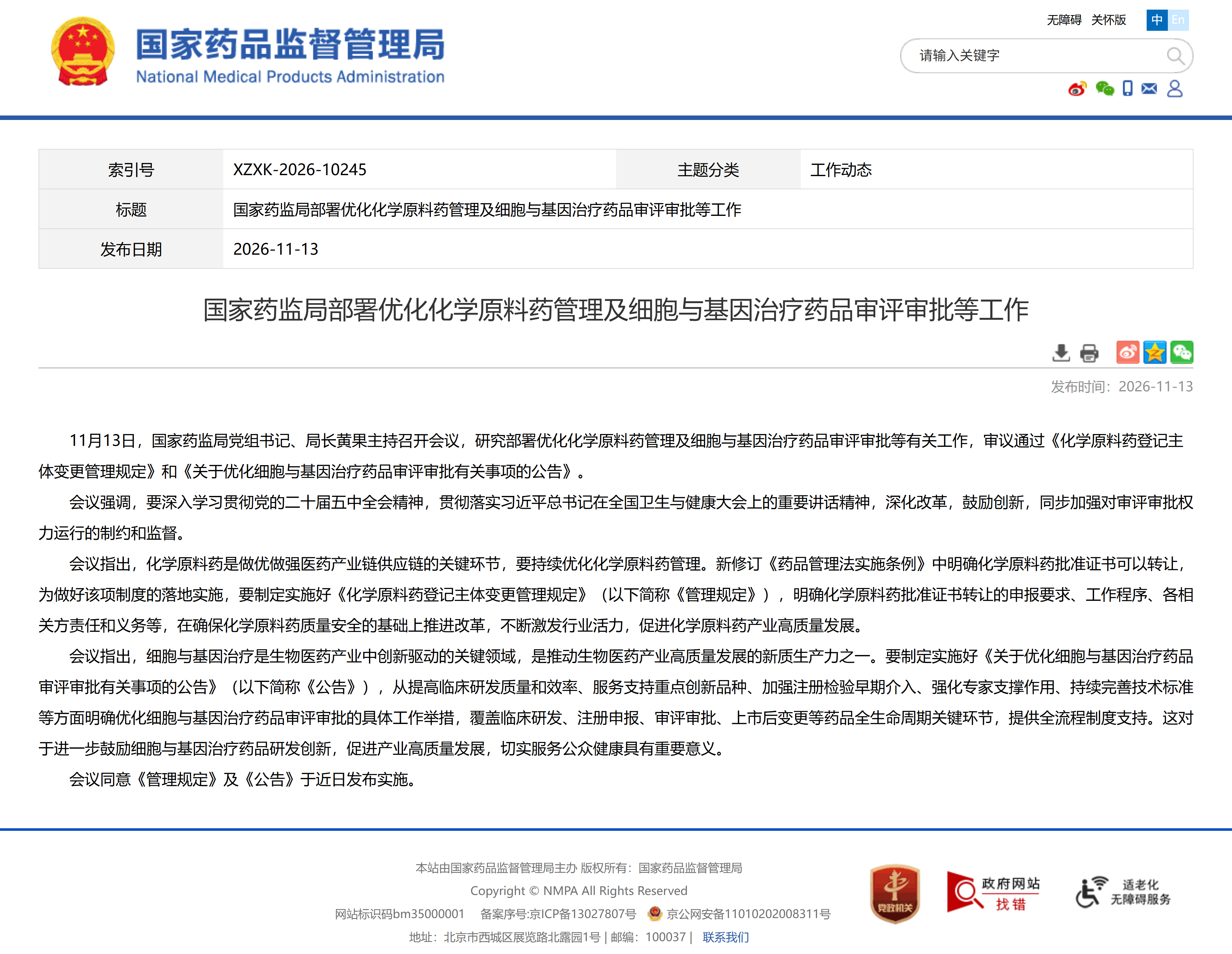
The two initiatives address different stages of the pharmaceutical industry. One focuses on improving the allocation and transfer of existing resources in the chemical API sector, while the other aims to support innovation in the rapidly developing field of cell and gene therapy. Together, they reflect China's efforts to improve regulatory efficiency while maintaining strict standards for drug quality and safety.
1. Changes to Chemical API Registration Entities: Facilitating Asset Transfers and Industrial Consolidation
The Provisions on Changes to the Registration Entity of Chemical APIs serve as an important supporting regulatory document for implementing the relevant provisions of the newly revised Regulations for the Implementation of the Drug Administration Law, which address the transfer of chemical API approval certificates.
The provisions are intended to clarify application requirements, administrative procedures and the responsibilities of relevant parties involved in changes to API registration entities.
For years, changes to API registration entities have presented practical challenges in corporate acquisitions, production capacity consolidation, technology transfers and adjustments to contract manufacturing arrangements. In certain cases, changes in ownership or manufacturing structures have required companies to repeat registration or related review procedures, increasing administrative costs and operational burdens while limiting the efficient allocation of established API resources.
Once implemented, the new provisions are expected to provide a clearer regulatory framework for legally changing API registration entities. Their potential implications include:
-
Facilitating asset transfers: Establishing a clearer regulatory pathway for changes to API registration entities and related asset transfers, subject to applicable requirements.
-
Supporting industrial consolidation: Providing greater flexibility for corporate acquisitions, capacity integration, contract manufacturing restructuring and the transfer of specialized API technologies.
-
Clarifying quality responsibilities: A change in registration entity does not automatically eliminate or transfer all quality-related obligations. Both the transferring and receiving parties must fulfill their respective responsibilities and maintain API quality control. Relevant risk assessments and coordination with downstream marketing authorization holders (MAHs) are also important.
Overall, the policy is expected to improve resource allocation across the chemical API industry, helping companies optimize manufacturing structures, integrate existing assets and strengthen supply chain stability.
2. Optimizing CGT Review and Approval: Supporting Innovation Across the Product Lifecycle
The meeting highlighted cell and gene therapy (CGT) as an important area of innovation in the biopharmaceutical industry.
The Announcement on Matters Concerning the Optimization of Review and Approval for Cell and Gene Therapy Products extends regulatory improvements beyond the clinical trial stage. It addresses key stages throughout the product lifecycle, including clinical development, registration applications, regulatory review and approval, and post-marketing changes.
The proposed measures focus on several areas:
-
Improving clinical development efficiency: Supporting global simultaneous development and international multicenter clinical trials to facilitate collaboration across research programs.
-
Prioritizing areas of unmet medical need: Giving greater attention to CGT products targeting malignant tumors, rare diseases and genetic disorders.
-
Bringing registration testing forward: Strengthening coordination between registration testing and technical review to reduce delays and repeated work during the later stages of regulatory submissions.
-
Enhancing technical expertise: Improving expert support to address the complex manufacturing processes, stringent quality control requirements and long-term safety considerations associated with CGT products.
-
Developing technical guidance: Continuing to improve technical standards and guidance for pharmaceutical development, nonclinical studies and long-term patient follow-up.
Compared with conventional small-molecule drugs and monoclonal antibodies, CGT products have distinctive characteristics in terms of personalized treatment, manufacturing complexity, quality control and long-term safety monitoring. These characteristics present specific challenges for regulatory review and approval.
The proposed full-lifecycle approach is expected to reduce regulatory uncertainty for innovative companies and improve coordination between development, testing and review. It may also provide more targeted regulatory support for emerging therapies, including CAR-T cell therapies and gene therapies, as they progress from research into clinical development.
3. Regulatory Direction: Balancing Industrial Development with Quality and Safety
The two policy initiatives address different but complementary needs across the pharmaceutical industry.
The reform of chemical API registration entity changes focuses on removing procedural barriers to the transfer and integration of established industrial resources. It is expected to support corporate restructuring, manufacturing capacity optimization and supply chain coordination.
The CGT review and approval initiative, meanwhile, focuses on emerging biopharmaceutical technologies. By improving regulatory communication, registration testing, technical review and post-marketing management, it aims to establish a regulatory framework better suited to the characteristics of innovative therapies.
At the same time, the NMPA emphasized the importance of strengthening oversight and checks on the exercise of regulatory authority. Encouraging innovation and improving review efficiency must go hand in hand with maintaining strict drug quality and safety requirements.
Regulatory optimization therefore does not simply mean lowering market entry standards. Rather, it seeks to improve the scientific basis, efficiency and adaptability of drug regulation while keeping risks under control.
4. Industry Implications and Outlook
The two policies have different areas of focus but share a broader objective: improving resource allocation and supporting innovation across China's pharmaceutical industry.
For chemical API manufacturers, clearer procedures for changing registration entities may provide a more predictable compliance framework for acquisitions, manufacturing structure adjustments and capacity consolidation. This could also give downstream pharmaceutical manufacturers greater flexibility in planning their API supply chains.
For CGT developers, improvements across the product lifecycle may enhance coordination among research, testing and regulatory review, providing more appropriate regulatory support for innovative therapies with significant clinical value.
Both documents are expected to be officially released in the near future. Relevant companies should monitor the final texts and supporting implementation requirements, and assess their potential implications for registration management, quality responsibilities, manufacturing arrangements and research and development activities.
As China's pharmaceutical regulatory framework continues to evolve, these initiatives may help create a more balanced environment for quality assurance, industrial consolidation and the development of innovative therapies.
| Enter Zhuocheng | Product | Honorary Qualifications | Contact Us |
| Company IntroductionFactory Appearance | Raw materials Premixed agent product OEM products |
Company:Jinan Zhuocheng Bio-Tech Co., Ltd. Corporate email:info@zhuochengbio.com Address:Building 3, Ligao International, 1222 West Aoti Road, Lixia District, Jinan |

