
China's API Trade in the First Half of 2026: Exports Remain Stable as Trade Uncertainty Increases
In the first half of 2026, China’s total imports and exports of active pharmaceutical ingredients (APIs) and intermediates reached USD 29.98 billion, representing a year-on-year increase of 6.7%. Exports totaled USD 23.44 billion, up 5.9%, while imports reached USD 6.54 billion, increasing by 9.7%.
Overall, China’s API and intermediate trade continued to grow, with exports remaining relatively stable and imports recording faster growth. However, changes in product composition, export prices, and the international trade environment indicate that the industry continues to face competitive pressure. Evolving global trade policies are also creating new uncertainties for future export performance.
1. The Share of API and Intermediate Exports Declines Slightly, While Their Import Share Continues to Rise
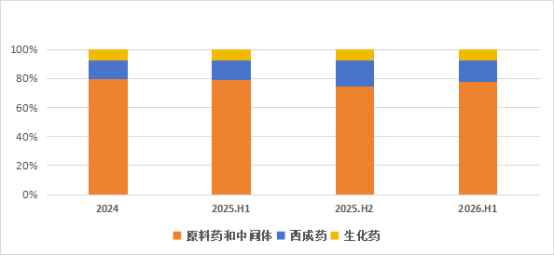
In terms of China’s western medicine export structure, APIs and intermediates have traditionally accounted for the largest share, generally maintaining a market share of around 80%. Finished pharmaceutical products and biopharmaceutical products together account for approximately 20%.
Since 2025, exports of finished pharmaceutical products have grown significantly faster than exports of APIs and intermediates. As a result, the share of APIs and intermediates in China’s western medicine exports declined slightly to 77.4% in the first half of 2026.
On the import side, APIs and intermediates have typically accounted for around 20% of China’s western medicine imports. However, this proportion began to rise in 2025, reaching approximately 24% and remaining at that level in the first half of 2026.
Continued price increases for certain basic chemical raw materials and intermediates have been an important factor driving import value growth. For example, in the first half of 2026, glycerol prices rose by a further 51.0%, following a substantial increase in 2025, contributing to a 97.8% increase in import value. Sulfate prices increased by 43.5%, while their import value grew nearly ninefold. By comparison, import prices for most other western medicine APIs and intermediates remained relatively stable.
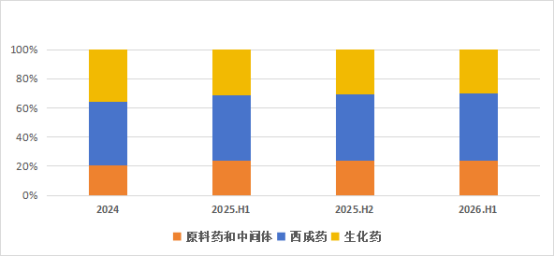
Overall, China’s western medicine trade structure underwent some changes in the first half of 2026. APIs and intermediates accounted for a slightly smaller share of exports, while their share of imports continued to increase. These changes reflect differing growth rates across pharmaceutical product categories and highlight the significant impact that price fluctuations in certain imported raw materials can have on trade values.
2. API and Intermediate Exports Remain Stable, but Price Competition Remains Intense
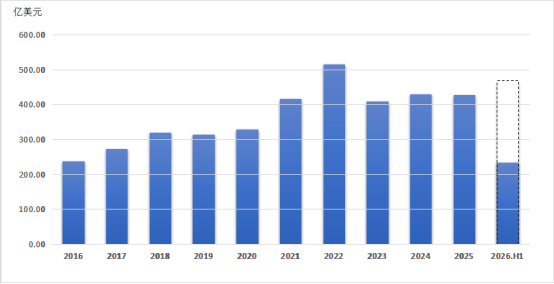
Over the longer term, China’s exports of APIs and intermediates increased from USD 23.75 billion in 2016 to USD 42.87 billion in 2025, representing a compound annual growth rate of 6.8%. This growth demonstrates that China continues to play an important role in the global pharmaceutical supply chain, supported by its well-established industrial ecosystem, large-scale manufacturing capabilities, and reliable supply base.
However, over the past three years, the industry has gradually shifted from rapid growth into a period of adjustment, with annual export values fluctuating around USD 42 billion.
This trend is largely attributable to two factors. First, global economic growth has come under pressure, while some overseas customers have continued to adjust inventory levels and manage purchasing schedules, slowing incremental demand. Second, international competition has intensified, requiring manufacturers to offer more competitive prices to retain customers and defend market share.
Data for the first half of 2026 indicate that overseas demand improved compared with 2025. China’s export volume of APIs and intermediates increased by 11.1% year on year, significantly exceeding the full-year growth rate of 2.2% recorded in 2025. This suggests a recovery in shipment volumes and export demand.
However, export prices indicate that competitive pressure remains substantial. In the first half of 2026, the average export price of APIs and intermediates was USD 2.77 per kilogram, up 1.8% from USD 2.72 per kilogram in the second half of 2025. Nevertheless, compared with the average of USD 2.91 per kilogram in the first half of 2025, the export price was still down 4.8% year on year.
This indicates that although export volumes increased, prices had not recovered to the level recorded in the same period of the previous year. Price competition therefore remains a key factor affecting manufacturers’ profitability. Meanwhile, the 5.9% year-on-year increase in export value in the first half of 2026 indicates that the sector maintained relatively stable growth in overall export scale.
Overall, China’s API and intermediate industry continues to benefit from strong global supply capabilities. However, the basis of competition is evolving. Manufacturers can no longer rely solely on scale and cost advantages to maintain market share. Optimizing product portfolios, improving manufacturing processes, strengthening quality management, and enhancing supply chain efficiency will be increasingly important for long-term competitiveness.
3. Rising Uncertainty in International Trade Policies Creates New Challenges for API Exports
China’s exports of APIs and intermediates remain broadly stable, supported by an integrated industrial ecosystem and large-scale manufacturing capacity. Nevertheless, as the global trade environment continues to evolve, international trade policies are having an increasingly significant impact on pharmaceutical supply chains and trade flows.
US tariff measures concerning pharmaceuticals, APIs, and intermediates have become a key area of industry attention. Relevant policies cover patented medicines and their active pharmaceutical ingredients, generic drugs, and trade investigations involving certain industrial capacities. These measures may further influence procurement decisions and manufacturing strategies across the global pharmaceutical industry. As the scope, effective dates, and implementation details of specific measures may change, continued monitoring is necessary.
From a supply chain perspective, the impact of tariffs extends beyond changes in import costs. Such measures may also accelerate adjustments in global pharmaceutical manufacturing and sourcing strategies. To reduce exposure to trade policy uncertainty and supply chain disruptions, major economies are placing greater emphasis on domestic production and regional supply chain development. Multinational pharmaceutical companies are also reassessing their global manufacturing footprints, raw material sourcing strategies, and supplier portfolios to improve flexibility and supply security.
For Chinese API manufacturers, these developments present both challenges and new requirements. In the short term, tariff changes and trade policy adjustments may affect export costs, customer purchasing schedules, and competitive conditions for certain products. Over the longer term, global supply chain restructuring will place greater emphasis on product quality, regulatory compliance, and international customer service capabilities.
In response to these changes, companies should closely monitor trade policy developments and relevant regulatory requirements in major economies. They should also assess risks across different markets and actively diversify their export destinations to reduce dependence on any single market. At the same time, strengthening customer relationship management, supply chain risk assessment, and cost control will be essential to improving resilience against external shocks.
As the global pharmaceutical supply chain continues to evolve, manufacturing capacity remains a fundamental strength of China’s API industry. However, future competitiveness will increasingly depend on the combined development of product portfolios, quality systems, market diversification, and risk management capabilities.
By consolidating existing supply advantages while proactively adapting to changes in the international trade environment, Chinese API manufacturers can better maintain stable export operations and strengthen their position in the ongoing restructuring of global pharmaceutical supply chains.
| Enter Zhuocheng | Product | Honorary Qualifications | Contact Us |
| Company IntroductionFactory Appearance | Raw materials Premixed agent product OEM products |
Company:Jinan Zhuocheng Bio-Tech Co., Ltd. Corporate email:info@zhuochengbio.com Address:Building 3, Ligao International, 1222 West Aoti Road, Lixia District, Jinan |

