

Tylvalosin Derivative V-28 Demonstrates Broad-Spectrum Antiviral Activity, Advancing Host-Targeted Antiviral Research
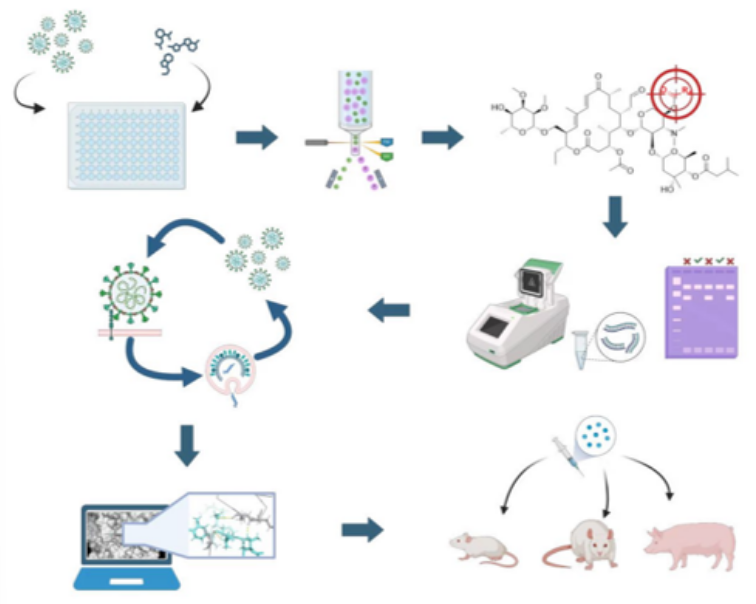
A research team from the Shanghai Veterinary Research Institute of the Chinese Academy of Agricultural Sciences (CAAS), in collaboration with Shanghai University of Traditional Chinese Medicine, Anhui Agricultural University, Hunan University of Chinese Medicine and other institutions, has made new progress in the development of host-targeted antiviral agents. Using the veterinary antibiotic tylvalosin as a lead compound, the team employed artificial intelligence-assisted approaches and conventional medicinal chemistry to optimize its molecular structure, resulting in the identification of a candidate compound, V-28. The study found that V-28 binds to the host protein STING and activates innate immune signaling, thereby exerting broad-spectrum antiviral activity during viral replication. The compound also demonstrated favorable pharmacokinetic properties and a promising preliminary safety profile. The findings were published in the Journal of Medicinal Chemistry, a leading international journal in medicinal chemistry.
Porcine reproductive and respiratory syndrome virus (PRRSV) remains a major threat to the global swine industry. Its rapid genetic variation and the limited cross-protection offered by existing vaccines highlight the need for new approaches to disease prevention and control. To address this challenge, the research team modified the molecular scaffold of tylvalosin and found that the introduction of aromatic groups could enhance antiviral activity. This approach led to the development of V-28, whose anti-PRRSV activity was nearly 20 times greater than that of the parent compound. Further investigations showed that V-28 does not directly inactivate the virus or interfere with viral attachment. Instead, it primarily inhibits viral replication. The compound also exhibited inhibitory activity against several other viruses, including porcine epidemic diarrhea virus, Japanese encephalitis virus, pseudorabies virus and feline calicivirus, with EC₅₀ values below 2.5 μM against each of these viruses.
Mechanistic studies revealed that V-28 directly binds to the host protein STING, with a binding dissociation constant (KD) of 7.85 × 10⁻⁷ M. This interaction activates the STING-TBK1-IRF3 signaling pathway and promotes the expression of interferon beta (IFN-β), enhancing the host's innate immune response and suppressing viral replication. These findings establish a mechanistic link between STING binding, innate immune activation and the inhibition of viral replication, offering a new direction for the development of host-targeted antiviral agents.
Pharmacokinetic and preliminary safety evaluations further demonstrated that V-28 has good metabolic stability in liver microsomes from pigs, rats and mice. Its absolute oral bioavailability in rats was approximately 33.11%. Preliminary safety assessments found no evidence of mutagenicity or significant hemolysis at high concentrations. In addition, no deaths were observed in animals following high-dose oral administration.
This study provides new insights into the structure-activity relationship of tylvalosin derivatives and expands the understanding of their potential antiviral properties and pharmacological functions. It also identifies a promising candidate compound and a new research direction for addressing viral variation and disease control challenges associated with PRRSV and other viral pathogens.
Yang Xiaopei and Long Yinghong, joint master's degree students at the Shanghai Veterinary Research Institute, CAAS, and Ma Rumeng, a doctoral student at the institute, are co-first authors of the paper. Zhou Wen, a researcher at the Shanghai Veterinary Research Institute, CAAS; Ke Xisong, a researcher at Shanghai University of Traditional Chinese Medicine; and Wang Zhenyu, an associate researcher at Anhui Agricultural University, are the co-corresponding authors. The research was supported by the National Key Research and Development Program of China and the National Natural Science Foundation of China.
Source: Shanghai Veterinary Research Institute, Chinese Academy of Agricultural Sciences
| Enter Zhuocheng | Product | Honorary Qualifications | Contact Us |
| Company IntroductionFactory Appearance | Raw materials Premixed agent product OEM products |
Company:Jinan Zhuocheng Bio-Tech Co., Ltd. Corporate email:info@zhuochengbio.com Address:Building 3, Ligao International, 1222 West Aoti Road, Lixia District, Jinan |

