
China Strengthens Veterinary Drug Regulation to Curb Low-End Capacity and Promote High-Quality Industry Development
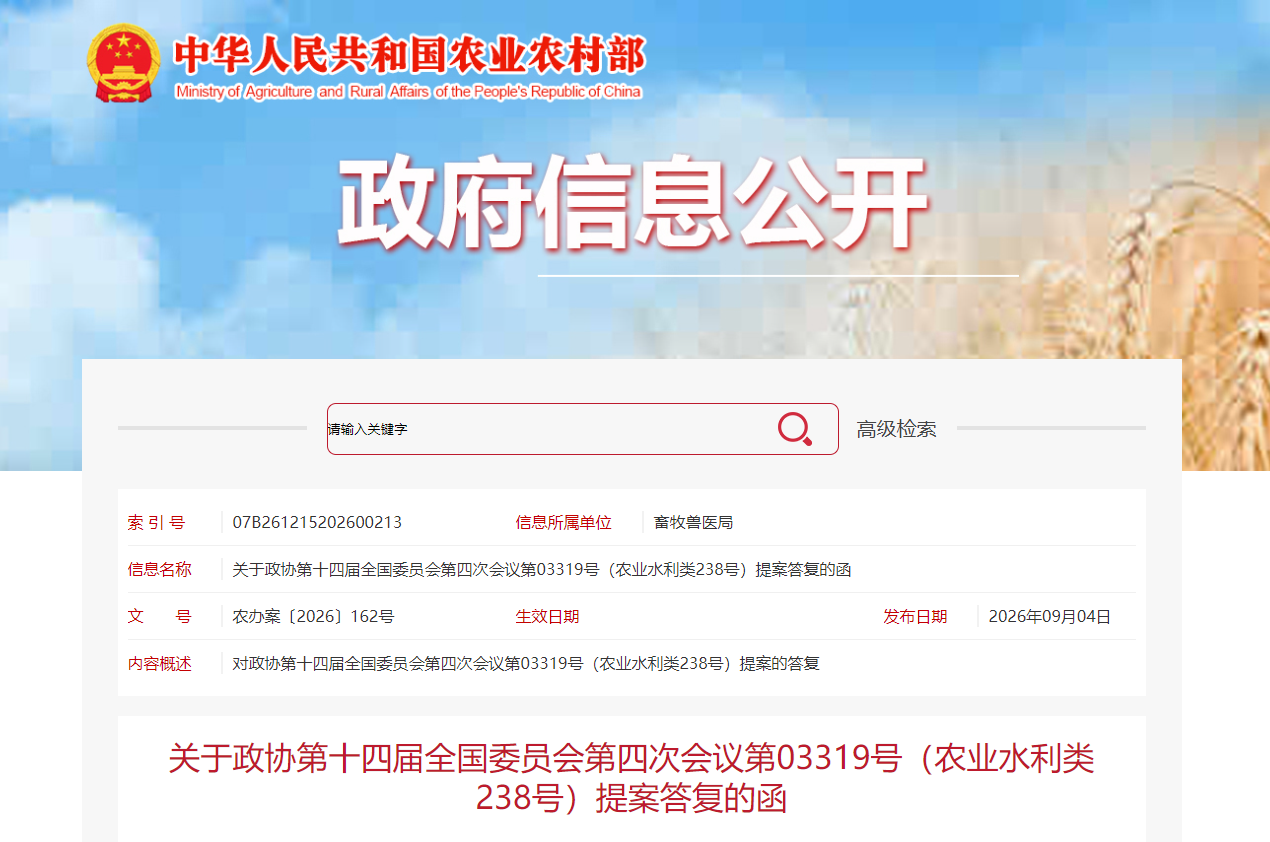
The Ministry of Agriculture and Rural Affairs of China (MARA) has recently responded to a proposal concerning the control of repetitive construction of low-end veterinary drug production capacity and the promotion of high-quality development across the veterinary pharmaceutical industry.
The response highlights several key areas, including controlling low-end capacity expansion, improving the utilization of existing production capacity, exploring contract manufacturing and the marketing authorization holder system, strengthening innovation, supporting talent development, improving financial support for technological innovation, and encouraging international investment and cooperation.
Controlling Low-End Capacity and Promoting Industrial Restructuring
MARA has emphasized the importance of high-quality development in the veterinary pharmaceutical industry and has introduced a series of policies to promote industrial upgrading.
These policies have encouraged the sector to move toward greener, more intensive, standardized and higher-quality development. At the production level, China continues to implement the updated Veterinary Good Manufacturing Practice (GMP) requirements while strengthening the review and supervision of veterinary drug manufacturers and product approvals.
According to the latest response, since 2022, 61 veterinary drug manufacturers have been closed or shut down, while 9,062 invalid veterinary drug approval numbers have been cancelled.
For generic veterinary drugs, China is also gradually introducing comparative testing and other technical evaluation approaches to raise technical entry requirements and encourage manufacturers to upgrade their products and production technologies.
The overall direction is clear: the industry is moving away from extensive capacity expansion toward greater emphasis on product quality, technological capability, compliance and manufacturing efficiency.
Improving Existing Capacity Utilization
Changes in livestock production models and veterinary drug demand have also affected capacity utilization across the industry.
MARA noted that some veterinary drug manufacturers are currently experiencing excess production capacity, while shortages remain for certain animal-health products. Improving the utilization and allocation of existing capacity has therefore become an important part of industry restructuring.
In recent years, regulatory measures have been introduced to explore more efficient use of existing production resources. For example, Announcement No. 263 allows qualified internal allocation and use of certain traditional Chinese veterinary medicine extracts within veterinary medicine groups, helping improve capacity utilization among related companies.
More importantly, MARA is currently studying the establishment of veterinary drug contract manufacturing and a marketing authorization holder (MAH) system.
MARA stated that these would represent significant changes to the existing veterinary drug regulatory framework. The specific requirements regarding contract manufacturing models, responsibilities of different parties and regulatory oversight require further research and evaluation.
The revision of China's Regulations on the Administration of Veterinary Drugs has already been initiated, with contract manufacturing and the MAH system among the areas receiving particular attention.
If introduced, these mechanisms could provide a clearer framework for separating R&D, marketing and manufacturing capabilities, while allowing qualified companies to make more efficient use of existing production resources.
Strengthening Innovation and Technological Development
Technological innovation is another major focus of China's efforts to promote the high-quality development of the veterinary pharmaceutical industry.
In 2025, China launched the “Hundreds, Thousands and Tens of Thousands” agricultural science and technology enterprise cultivation initiative. Under the program, 45 young professionals were selected as the first group of technology executives and assigned to 44 agricultural enterprises to help address technical challenges in production and R&D.
Talent development is also being strengthened. Since 2009, MARA, the Ministry of Education and relevant provincial governments have jointly supported the development of 29 agriculture-related universities, encouraging them to strengthen disciplines and optimize academic programs based on agricultural industry needs.
Veterinary public health and other emerging fields are also being incorporated into higher education and professional training.
These initiatives are intended to strengthen the connection between scientific research, professional talent and industrial applications.
Financial Support for Technology Innovation
Financial policy is also being used to support technological development and commercialization.
The National Financial Regulatory Administration, together with relevant government departments, has introduced policies aimed at expanding technology insurance products covering key stages such as R&D, technology transfer and industrial commercialization.
These products include insurance covering R&D expenditure risks, technology commercialization costs, and comprehensive insurance for first-of-a-kind equipment and first batches of innovative products.
Such measures are designed to improve risk-sharing mechanisms and help companies move technologies from research and development toward commercial application.
For veterinary pharmaceutical manufacturers, this could provide additional support for investment in new technologies, process upgrades and innovative product development.
Encouraging International Investment and Global Market Development
China is also encouraging greater international participation in the veterinary pharmaceutical sector.
Under the Catalogue of Industries for Encouraging Foreign Investment (2025 Edition), several veterinary pharmaceutical fields have been included in the encouraged investment categories, including:
-
Production of animal-specific antibacterial APIs;
-
Production of new veterinary antibacterial, antiparasitic and insecticidal products and formulations;
-
Production of new veterinary vaccine products and formulations.
The policy is intended to attract international capital, technology and expertise into China's animal-health sector while promoting cooperation between domestic manufacturers and global markets.
For veterinary API manufacturers, international competitiveness increasingly depends not only on production capacity, but also on quality systems, regulatory documentation, product consistency, manufacturing standards and supply reliability.
Closer alignment between China's veterinary drug R&D and manufacturing standards and international standards is therefore expected to support the expansion of Chinese veterinary pharmaceutical products into overseas markets.
Revision of the Veterinary Drug Regulations
Looking ahead, MARA stated that it will continue improving veterinary drug policies and regulatory measures and advance the revision of China's Regulations on the Administration of Veterinary Drugs.
The authorities also plan to improve information disclosure within the veterinary pharmaceutical sector and regularly publish lists of veterinary drugs urgently needed for R&D, helping guide investment and research toward areas of market demand.
At the same time, China plans to further promote the digitalization and rule-of-law development of veterinary drug regulation and strengthen alignment between domestic veterinary pharmaceutical standards and international requirements.
The latest measures also emphasize supporting the international expansion of domestically developed innovative veterinary medicines.
From Capacity Expansion to Quality and Innovation
The latest policy developments indicate that China's veterinary pharmaceutical industry is entering a stage in which capacity expansion alone is no longer sufficient to ensure sustainable competitiveness.
Industry development is increasingly focused on optimizing production structures, improving capacity utilization, strengthening technological innovation and enhancing international competitiveness.
For veterinary API and finished-product manufacturers, competition is likely to increasingly extend beyond production scale and pricing to include R&D capabilities, manufacturing technology, quality management, regulatory compliance, supply-chain reliability and international market service.
As GMP supervision continues to strengthen, low-end repetitive capacity faces increasing pressure, while potential reforms involving contract manufacturing and the MAH system may create new opportunities for more specialized allocation of R&D, manufacturing and commercialization capabilities.
At the same time, technologies such as synthetic biology, green manufacturing, intelligent production, advanced formulations and innovative veterinary medicines are expected to become increasingly important areas of industry development.
For China's veterinary pharmaceutical industry, the current transition represents more than a capacity adjustment. It reflects a broader shift from scale-driven growth toward quality-, technology- and innovation-driven development.
| Enter Zhuocheng | Product | Honorary Qualifications | Contact Us |
| Company IntroductionFactory Appearance | Raw materials Premixed agent product OEM products |
Company:Jinan Zhuocheng Bio-Tech Co., Ltd. Corporate email:info@zhuochengbio.com Address:Building 3, Ligao International, 1222 West Aoti Road, Lixia District, Jinan |

